

FAMILY OWNED. LOCALLY OPERATED.
PXSPEED: LAS VEGAS SPEED DEVELOPMENT
Serving Henderson, Summerlin, Inspirada, Green Valley, Anthem, Seven Hills, Southern Highlands, and Centennial.
Most speed training is guesswork dressed up as coaching. No numbers, no proof, just "trust us, you're getting faster." We don't work that way. Every session at PXSPEED is measured. We capture data and video on the spot, so athletes see exactly where they stand and exactly how much they've improved that day, not someday. No assumptions. No "we think it's working." Documented results you can watch and track.
SPEED MATTERS FROM YOUR FIRST STEP TO YOUR LAST
A common myth: athletes think they're at full speed the moment they take off. The opposite is true. The first step is the slowest part of any sprint. Getting fast off the line and staying fast to the finish are two different skills, and most training only builds one. Speed takes most athletes 30 to 60 yards to reach full velocity, depending on age and training level.
Our athletes at minimum increase their speed by 2 to 3 mph in a short training window. Picture two athletes running flat out for 6 seconds, one at 14 mph, one at 17 mph. The first covers 123 feet. The second covers 150, a 26 foot gap, almost 9 yards, nearly a full first down, opening up in the span of a single play. Same effort, same six seconds. One athlete is just gone.
That gap isn't only about who's faster at top speed. It's also about who gets there first. An athlete who reaches full velocity in 20 yards instead of 40 is covering more ground at max speed for the rest of the play, not just running faster once they arrive. Train the first step and you shrink the distance it takes to hit top gear. Train top speed and you raise the ceiling once you're there. Athletes who improve both aren't just a little faster. They're covering more ground in the acceleration phase and more ground once they're flying, and those two gains stack on top of each other.
Every sport rewards that differently. It's the running back pulling away from the last defender, the soccer player reaching the through ball first, the base runner turning a single into a double, the wrestler closing on a shot a fraction of a second faster. Whatever the sport, more ground covered in less time is the difference between getting there and getting beat. That 3 mph isn't a number on a sheet. It's the distance between getting caught and being uncatchable.
TWO METHODS, ONE FASTER ATHLETE.
Speed training isn't a single formula every coach teaches the same way. It's a craft, and it looks different from coach to coach. At PXSPEED, we train it through two distinct methods, and we use both, because real speed development takes acceleration, top speed, and force output, and no single method builds all three on its own.
Ground-based speed training. This is the strength and power foundation: explosive force into the ground, the same quality that drives a vertical and a broad jump. As our athletes' verticals climb and their broad jumps get longer, that's the engine getting stronger. We test the vertical jump on a Vertec, the same standardized measure used at combines, so an athlete's number means something and stacks up against real benchmarks. We track it over a program and watch it climb.
Machine-based speed training. This is our treadmill work. The treadmill doesn't wait for an athlete to build to top speed over 30 to 60 yards, it puts them there immediately, training form, acceleration, and top-end mechanics all at once. That's exactly why coaching matters here more than anywhere else. Bad mechanics at top-end velocity don't just slow an athlete down, they raise injury risk. Every rep at that speed is coached in real time, watching form and correcting it on the spot, because the machine creates the velocity, but the coaching is what gives an athlete the best chance to handle it well.
An athlete who only trains one of these gets stronger, or gets faster on the machine, not both. Ours train the strength behind the sprint and the sprint itself, together.Real athletes. Local results.
REAL ATHLETES, LOCAL RESULTS.
These are local athletes, kids from right here in the valley, trained in this building, with results we measured ourselves. Not stock numbers borrowed from a facility three states away.
Speed changes more than the stopwatch. We've watched that gain turn into confidence, and confidence into playing time: athletes who went from a few minutes off the bench to a starting spot, from role player to one of the best on the team. We've seen it.
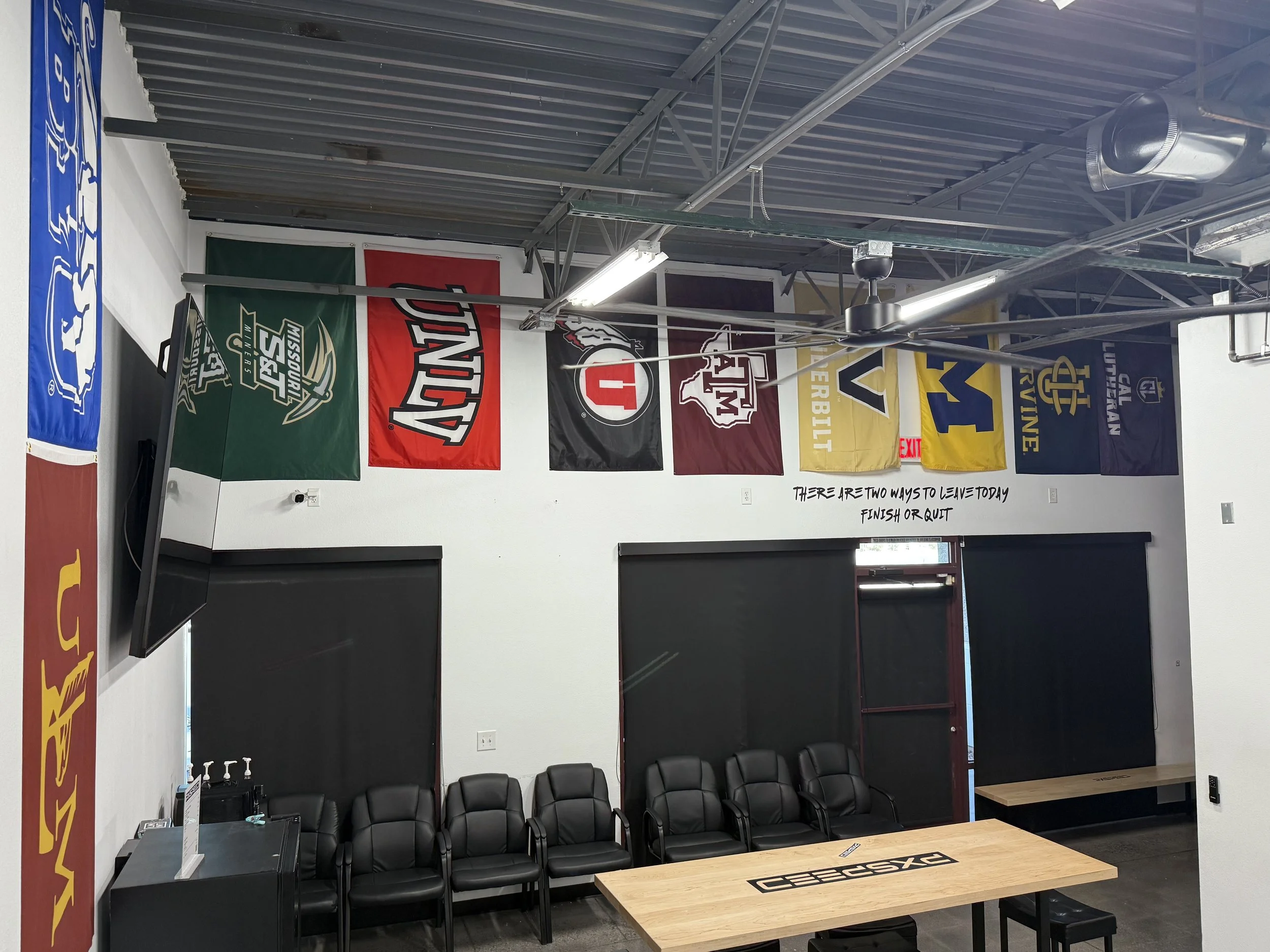
This is why we build complete athletes across every sport: football, flag football, soccer, basketball, baseball, track, volleyball, softball, wrestling, lacrosse, gymnastics, and more. We've trained 500+ athletes from youth through college, including athletes now competing in the Big Ten, SEC, Big 12, Sun Belt, Mountain West, and Big West, plus NCAA Division III and junior college programs.
Anyone can say they make athletes faster. We have the data, the video, and the athletes to prove it.
THE SESSION
We coach speed and agility as a skillset, and that skill has to be coached rep by rep or bad habits will keep getting reinforced. Footwork precision and multi-directional agility are built the same way, rep by rep, inside this same coaching structure, not as a separate add-on. That's why every session runs 60 minutes with a maximum of 7 athletes. It's a group environment, not a group class. Athletes train together and feed off each other's energy, but the program is built around the individual. They move through the session together, sometimes on the same drill, sometimes with different weights, progressions, or movements based on what each one needs.
Every session blends ground-based strength and power work with machine-based treadmill training, because real speed development takes both, not one or the other.
A coach is on every athlete, every rep, watching mechanics, correcting in real time, and adjusting on the fly. If something's off, we fix it on the next rep, not next week. No reps are wasted reinforcing bad habits.
Every rep coached. Every detail addressed. Every session built around the individual.
HOW OFTEN TO TRAIN
Our sessions are deliberately intense and form-focused. We're rebuilding how an athlete moves, accelerates, and produces force. That kind of work taxes the central nervous system, not just the muscles, so recovery isn't optional, it's part of the program. The science is a framework, not a rigid rule: we program frequency and intensity to the athlete in front of us. Speed is built through quality, not random volume.
1x per week, Maintenance. Preserves and sharpens the speed an athlete already built, without stealing recovery from games, practice, and competition. The goal here isn't new gains, it's keeping them fast and fresh through the season instead of losing ground. Your athlete shows up to their sport faster, not gassed from an extra workout.
2x per week, Growth. This is where real speed is built: acceleration, top-end, and power. Two quality sessions, one to two days apart, give the nervous system enough stimulus to adapt and enough recovery to rebuild stronger. It's the floor for actual development, not the cap.
3 to 4x per week, Peak (by assessment). The fastest development happens here, but only for athletes cleared for it: older or advanced athletes, off-season, with the recovery capacity to handle it. We program each session to hit a different system, acceleration one day, top-speed mechanics another, so the work compounds instead of breaking the athlete down. This isn't open to everyone, and it's not "more is always better." At this volume, coaching the recovery matters as much as coaching the reps. We assess the athlete first.
For measurable results, consistency beats count: 10 to 16 sessions, stacked, not scattered.
Twelve sessions across twelve weeks builds an athlete. Twelve sessions across six months just resets your baseline every visit. Speed adaptations are perishable, so sessions spaced too far apart turn every workout into a re-introduction instead of a progression. The athletes who see real jumps in 40 times, vertical, and change-of-direction scores show up every week, for 8 to 12 weeks straight. That's when form locks in:
(weeks 1 to 3) Power and acceleration climb.
(weeks 4 to 8) The new ceiling becomes the new floor.
(weeks 9 to 12+) Missing a week here and there for games, travel, or illness is fine, the system tolerates it. But treating sessions like a punch card works against the biology of how speed is built.